
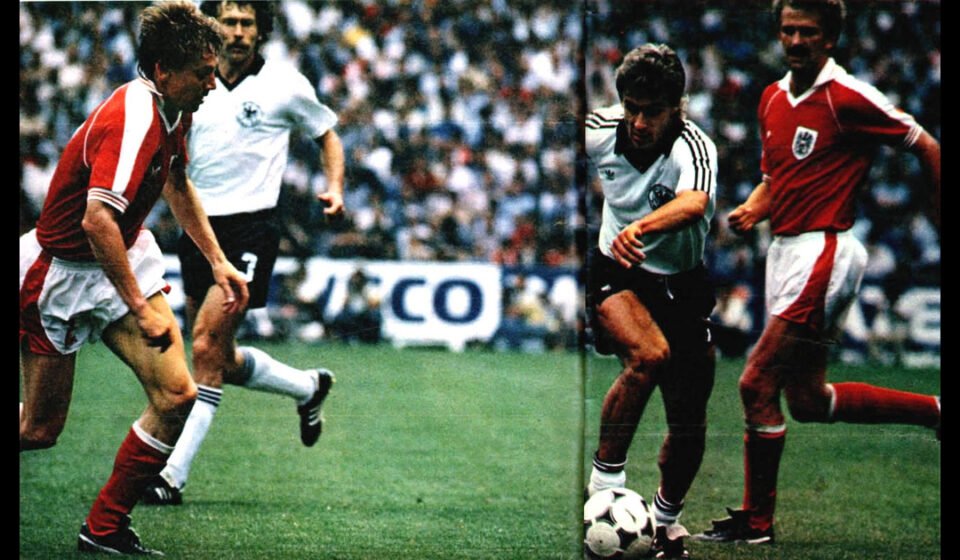

When Algeria met Austria on June 28 in the final Group J game at the FIFA World Cup 2026, it carried the enormous weight of history. The contest lived up to the occasion with a thrilling 3-3 scoreline that ensured both teams advanced to the knockout stage.
Both teams knew before the game that a draw would be enough for them to go through at the expense of Iran. Yet, they went for the win, with Riyad Mahrez’s goal in the third minute of stoppage time putting Algeria ahead. At that point, Iran were set to qualify for the Round of 32, with Austria heading out.
But a dramatic 96th-minute header by Sasa Kalajdzic salvaged a point for Ralf Rangnick’s team, and they kept their World Cup hopes alive. For Algeria and their fans, this was justice and things finally coming full circle for them. The spirit in which this game at the Arrowhead Stadium in Kanas City was played could not have been different than what their fans witnessed in Gijon in the 1982 World Cup match between West Germany and Austria.
Algeria’s stunning start at the 1982 World Cup
The 1982 World Cup saw Algeria qualify for the showpiece occasion for the first time in their history. Their fans would have been forgiven for thinking that reaching the tournament was big enough for them, and perhaps that was even true. But the Desert Warriors had plans to extend their stay in Spain beyond the first group stage.
They were pitted against Austria, Chile, and West Germany. All three sides appeared well ahead of the North African nation when it came to the global stage. Algeria’s first game was a daunting prospect against the Germans.
In fact, reigning European champions were so sure of their success that Paul Breitner is alleged to have said that they would dedicate the seventh goal to their wives and the eighth to their dogs ahead of the opener against their less fancied opponents. But Algeria produced one of the greatest World Cup shocks, beating West Germany 2-1 in the first game at El Molinón in Gijon.
Rabah Madjer put his side ahead before Karl-Heinz Rummenigge levelled for the Europeans in the 67th minute. Parity lasted only a minute as Lakhdar Belloumi scored what turned out to be the winner. This was the first time that an African nation beat a European team at the World Cup. The next game against Austria turned out to be different, with Das Team securing a 2-0 win.
Algeria bounced back in emphatic fashion as they held off Chile to register a 3-2 win. They had raced into a 3-0 lead at halftime with a brace from Salah Assad and a strike from Tedj Bensaoula. While the South American side hit back with two goals in the second half, it wasn’t enough, as Algeria became the first African team to win two games at a single World Cup.
This took their tally to four points (2 points for a win) and put them at the top of the table. Still, they were not sure of progress because the last game of the group was yet to be played. Remember, this was an era when the final group matches were not played simultaneously. Both West Germany and Austria were scheduled to play each other a day after Algeria’s win over Chile, and they knew what they needed.
The equation
Following their historic and entertaining wins over West Germany and Chile, Algeria had become the neutrals’ favourite. Yet, their fate remained out of their hands. Before the game, the equation for all three teams in contention to progress was made clear.
If West Germany won by more than three goals, they and Algeria would qualify at the expense of Austria. A German win by exactly three goals would require their opponents to score at least two goals in order to progress.
A win or draw for Austria would see them and Algeria reach the next round, and West Germany eliminated. Meanwhile, a narrow 1-0 or 2-0 win for West Germany would see the African team go out on goal difference. To say that drama was expected would be an understatement.
Disgrace of Gijon
Spanish football fans flocked to the El Molinón and packed the stadium, hoping to witness history unfold. They did see history being made, but for all the wrong reasons.
West Germany started on the front foot and were ahead inside 10 minutes. A Horst Hrubesch strike made it 1-0, and there was hope that the Germans could score more, which would help Algeria’s cause. Both teams created chances in the early exchanges, and Paul Breitner, who talked about dedicating goals to wives and dogs, missed an opportunity to double Germany’s lead. But around the half hour mark, the complexion of the match soon changed.
41,000 fans inside the stadium witnessed risk-averse football from both teams afterwards. With the danger of elimination ever-present, it was perhaps somewhat understandable that both teams would not go gung-ho in attack to leave gaps and be a little more pragmatic. But this wasn’t defensive football; it was just a shambolic mockery of the beautiful game, and it is important to understand why.
After the opening goal, Austria could have felt that the Germans could run riot against them to end their tournament. Die Mannschaft, on the other hand, could have been wary of being hit back with a goal to jeopardize their chances; hence, they had every reason to try and score more. Instead, both sides were happy to keep the scoreline that would see them go through at the expense of Algeria as if a silent pact had been secretly signed.
Both sets of players had no issues to having a kick about without threatening the other goal. Karl-Heinz Rummenigge’s 54th-minute attempt from distance remained the final shot on goal by either side until the final whistle. When Rummenigge was substituted in the 66th minute, the fans booed and jeered heavily.
The large Spanish crowd that had come to watch a spectacle let the players know what they felt with chants of “Que se besen, que se besen” (“Let them kiss, let them kiss”) directed at them. The Algerian fans in attendance, who were seeing their country’s hopes of progress slipping away, waved currency notes at the players.
As the game petered out, German ARD commentator Eberhard Stanjek, at one point, refused to commentate on the game, saying it was “shameful” to see what was going on. His Austrian counterpart, Robert Seeger, pulled no punches and asked viewers at home to turn off their television sets. In the UK, ITV’s Hugh Johns had a lot to say.
“Quality players who should all be put in the book of referee Bob Valentine for bringing the game into disrepute. This is one of the most disgraceful international matches I’ve ever seen… This crowd is disgusted that West Germany could come here and win so gently, so easily, in a canter, allowed to by an Austria side who never got into anything approaching second gear, let alone top gear. Austria never set out to win this game at all, they knew that a 1-0 defeat to West Germany would ensure that both teams would get through to the second stage.”
Scottish referee Bob Valentine blew the final whistle that sent both teams through to the next stage, and Algeria’s dream run was over. The match would forever go down as the Disgrace of Gijon.
Aftermath
The footballing world, except for the teams of West Germany and Austria, was up in arms. West Germany fans surrounded their team’s hotel and protested, only to be pelted with water bombs by the players. The press was unforgiving.
The media of both countries slammed the actions of their players, and El Comercio, the local newspaper in Gijon, took things to another level, printing the match report in its crime section. West Germany would reach the final of the 1982, but were resoundingly beaten by 3-1 by Italy.
The Algerian FA didn’t sit on its hands. They lodged a complaint to FIFA, but the governing body couldn’t expunge the result since there was no clear and hard evidence of corruption or the fact that Austria and West Germany had colluded to eliminate Algeria from the World Cup. The result stood, but it led to a big change in the competition.
Starting from the 1986 World Cup in Mexico, it was ruled that the final games in every group would kickoff at the same time so that no team could take the field knowing how the other result would impact its chances.
Still, for Algeria, the memories of 1982 and Gijon remained painful. In 2014, they faced Germany in the last 16 of the World Cup. In the build-up, the then-Algerian coach Vahid Halilhodzic made it clear that they had “not forgotten” the events of Gijon after all those years. Germans eventually beat the African side 2-1 in extra time.
Now, at the 2026 World Cup, the final group game against Austria presented Vladimir Petković’s side the chance to right the wrongs of the past. A win for either side would have seen Iran progress at the expense of the losing team, and a draw would have secured passage for both Algeria and Das Team.
Yet, there was no repeat of anything resembling the non-aggression that unfolded in Gijon in 1982. Instead, it was the exact opposite. Both teams traded blows and served up a 3-3 thriller, which saw Austria save their World Cup campaign at the death and Algeria move to the next round.
While some Iran fans and a few skeptics might question this outcome that suited both sides, the truth is that 44 years after the events of the World Cup in Spain, the Desert Warriors might have finally buried the ghost of Gijon in Kansas City.